

Last Updated: September 16, 2026
Table of Contents
Introduction: Why Every Second Counts
Think about it. A frantic-pace shopping center, a middle-aged man drops to the ground. Chaos erupts, but an onlooker rushed in, started compressions and grabbed the nearest AED. Within minutes paramedics arrived at the man started breathing, and regained his heartbeat-because that onlooker became certified to give CPR.
CPR AED training enables you to act quickly and competently in a cardiac emergency, frequently before help can arrive. Here we break down the purpose, perks of CPR and AED training, as well as the logistics behind gaining these capabilities. CPR and the Role of AEDs
In the event that someone suffers sudden cardiac arrest, things can change in seconds. A person becomes unresponsive and stops normal breathing, leaving hardly time to think. Emergency services do a fantastic job; however, equipped individuals can start making a difference before help arrives. In these cases, CPR and AED training supplies a blueprint on how to assist instead of observing helplessly.
The benefit to certification is not just about learning the steps involved. The training helps the people in the room identify an emergency situation, knows to call for assistance, work together with neighbors, schoolmates, colleagues, gym mates and all others around them.
What is CPR AED Certification?
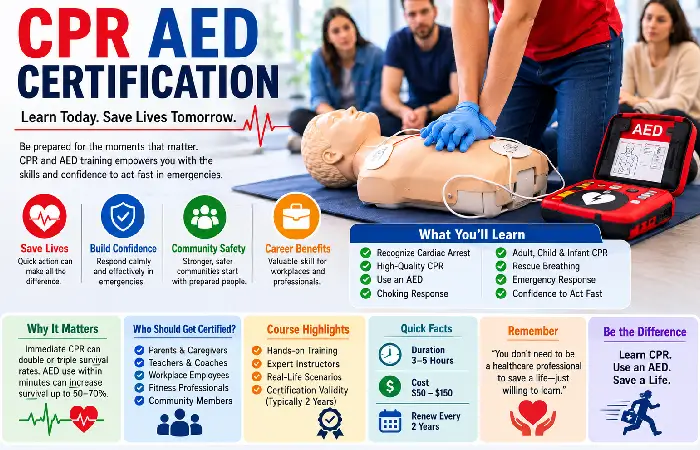
What is the CPR AED? A CPR AED certification is a class in which participants learn about how they should behave when someone has a heart emergency.
CPR (Cardiopulmonary Resuscitation.
AED (Automated External Defibrillator
It’s a powerful combination of training by teaching these two vital life-saving skill set to our participant, they can return on any incident as prepared.
Internal link Suggestion: Link to “What our First Aid and CPR courses cover”.
Understanding the Role of CPR
CPR aims to pump blood throughout the body that is normally being pumped by a stopped heart. This training will instruct you on how to identify and react to an unresponsive victim; the key is speed and effective action while awaiting the arrival of medical personnel.
You will typically also get some hands-on experience, and an opportunity to practice chest compressions and may be mouth-to-mouth resuscitation skills plus guidelines on doing CPR on adult, child and infant.
Understanding the Role of an AED
The purpose of an AED is to study a person’s heart rhythms and if a shock is required, deliver one. The AED guides users through the process with voice or visual cues. That’s why training in AED operation is of value for those not on the medical field.
Through practice, students discover ways to secure the AED, make decisions that the prompts guide, and the synchronization with CPR application. There will be instructions too regarding following instructions and people touching any patient’s body during shocking an AED.
As AEDs are intended for use by trained members of the public (as well as emergency services), having an awareness of their location is a valuable part of a “prepare and respond” approach to emergencies.
What Happens During a CPR AED Course?
Most CPR AED courses will include a combination of lecture, demonstration, and physical practice. In a course, you might be taught to identify cardiac arrest and how the most common first response works, then the course students practice skills on the CPR manikins and CPR AED trainers.
This practical element gives participants an opportunity to gain familiarity with the physical performance of CPR. It also provides an opportunity to make mistakes in a relatively low risk environment and receive advice from an instructor.
Depending on the course and provider, participants may cover:
- Recognition of cardiac arrest
- Activation of emergency medical services
- Adult CPR
- Child CPR
- Infant CPR
- AED operation
- Choking response
- Rescue breathing
- Emergency response coordination
- Safety considerations during AED use
The content may differ depending on the awarding body, certification level, and target groups
Survival Statistics: The Impact of Training
Time is critical in cardiac emergencies. Studies show:
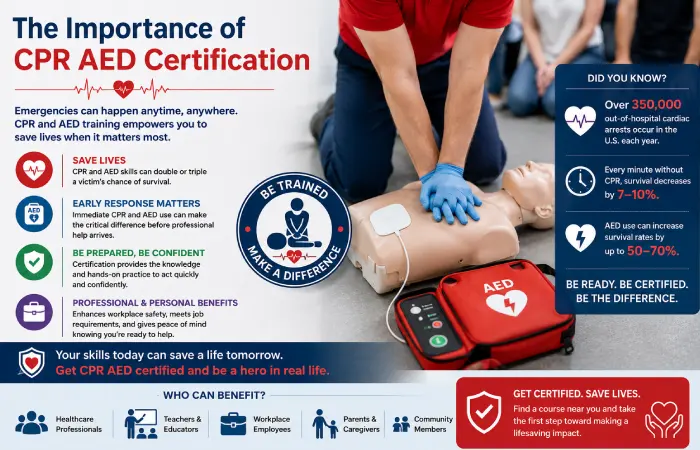
- Immediate bystander CPR can double or triple survival rates in out-of-hospital cardiac arrests.
- AED use within the first few minutes can increase survival chances to 50–70%, compared to less than 10% without intervention.
- Nearly 70% of cardiac arrests occur at home, highlighting the importance of training family members and close contacts.
So the statistics speak volumes – time and speed are critical factors and CPR AED Certification is quite literally life support in a card.
For current evidence and statistics about CPR and cardiac arrest, readers can also review the American Heart Association’s CPR facts and statistics.
These statistics also point to why emergency preparedness isn’t just for healthcare providers. Cardiac emergencies occur in settings outside a hospital, doctor’s office, or while a vehicle is in transit. Trained bystanders therefore may have a chance to initiate CPR and/or administer a shock with an AED before professional medical help arrives.
Early action is also related to the concept of the Chain of Survival. The Chain of Survival is a sequence of connected actions that should work together to increase the chances of a patient surviving cardiac arrest. There are five links in the chain: recognition and response, early defibrillation, early CPR, professional and advanced care and post-arrest care and rehabilitation.
Why Early Action Matters
There is reluctance when you are scared of doing something wrong. The training instills this basic flow process, diminishing uncertainty. In some instances, doing something is better than doing nothing; checking response, getting help, and starting compressions.
A certified responder should still follow the guidance learned during their course and the instructions provided by emergency dispatchers and AED equipment. Certification does not make someone a medical professional, but it can prepare them to provide immediate assistance within the scope of their training.
The Importance of CPR AED Certification
1.
Immediate Response Saves Lives
Minutes without compressions or the defibrillator’s electrical shock cut the chances of survival down by 7-10 percent each time, so a trained person can intervene early and often save a life. A trained person can start the immediate care protocol faster than anyone can when an ambulance or EMT takes over.
Early actions will be to recognize that there is an emergency; get help, in the form of an ambulance, on the way; get another person to look for the AED and call for 911; initiate CPR, if applicable.
Trained response is also able to direct the other bystanders. Rather than everyone acting alone, one person can dial the emergency number, another retrieve the AED, and someone can be assisting with CPR.
2. Versatility in Emergencies
Learn to handle cardiac arrest, choking, or any form of respiratory trouble and know how to tackle an array of life threatening emergencies safely and confidently.
This can allow Certification to be beneficial for people in numerous different surroundings. Whether a parent using knowledge at home, a teacher using it at school, an employee in the office, every emergency is varied and to a varying degree, a qualification based on having basic knowledge of how to treat urgent situations is helpful.
3. Community Safety Enhancement
This can allow Certification to be beneficial for people in numerous different surroundings. Whether a parent using knowledge at home, a teacher using it at school, an employee in the office, every emergency is varied and to a varying degree, a qualification based on having basic knowledge of how to treat urgent situations is helpful.
The value of community preparation is greatest in settings that serve multiple people. Schools, offices, recreational areas, malls, community buildings all profit when those in them can assist with rudimentary emergency help.
4. Workplace Preparedness
Workplaces have a requirement to get employees certified. This is in the workplace so that skilled responders are on premises, making the workplace safer.
CPR AED training at work could be particularly useful if people are working in close quarters for long periods of time or if an AED is on site. Workplaces might also set up emergency plans, and include such things as who should dial for help, who should fetch an emergency pack and who will administer aid.
The type of certification and requirements can vary across workplaces, and by job and local mandates. Each and every employee needs to verify which certification requirements are necessary for his or her particular job role instead of presuming that all certifications require the same things.
5. Legal and Ethical Considerations
Some jobs will require CPR AED certification by law. Morally it should be about having civic duty, knowing how to save a life when it counts.
Specific certification standards might apply to professionals working in sectors such as education, childcare, childcare, healthcare, fitness and many others. Rules could vary greatly depending on the job responsibilities and locality – so workers will need to confirm with employers or any relevant licensing body.
Also beyond formal requirements it can be reassuring to know how to perform CPR/use and AED. Knowing how to be “in action” if someone needs to go right then now can help when it comes to being “able”.
6. Confidence During an Emergency
Emergency situations are frightening, and not everyone knows how to react with an unresponsive person. CPR AED training gives participants a chance to practice your actions ahead of a real emergency. Participants find hands-on training beneficial: practicing with equipment is a must and an instructor will provide assistance.
ensuring participants remember basic steps through repetitive actions until it comes second nature during an emergency. Confidence, though it shouldn’t be confused with overreaching the scope of your training, will arise in a trained responder, as will an understanding of what to do with emergency resources and professionals as they arrive.
7. Useful for Home and Family Safety
CPR AED certifications may be beneficial for friends and family of the rescuer because cardiac arrest events occur all of the time – even at home. Someone present may be able to assist the other with calling 911 while one person begins compressions.
Families can be aware of an emergency plan beforehand too, knowing where to go, who to call for assistance and whether the nearestAED device is accessible should one be needed.
8. Helpful for Caregivers and Community Members
In particular CPR AED training is beneficial to the chronic caretaker. Educators, teachers, coaches, child care providers and community volunteers may spend substantial amounts of their time managing others and should know the procedures applicable to the respective duties.
The proper certifications may vary by role. Those who are seeking certifications should be sure to obtain courses to fit their duties or the needs of their work environment.
How to Get CPR AED Certified
Getting certified is accessible and straightforward:
- Choose a Provider: Known courses are provided by entities such as the Red Cross or the AHA.
- **Select a Format:**Training could be live, over the web, or a combination of the two.
- Complete the Course: Typically 3–5 hours, covering adult, child, and infant CPR, AED use, and choking response.
Cost: Courses range from $50–$150, depending on provider and format.
Internal Link Suggestion: Link to an online signup page or directory of certified CPR AED courses.
Choosing the Right CPR AED Course
This step is needed because it’s a requirement that each person needs some certification. Know your audience is what people call it; is it workplace responder, general, healthcare professional, care givers of young children, teachers etc. Then sign up.
Consider whether the training involves any practical experience. CPR and AED response includes physical procedures, and hands-on experience can be beneficial to your training. Know how the certification is issued, and whether the class meets your needs (including any requirements of your job).
Participants who are required to provide a certification for their work should check with their prospective employer for acceptable course providers and type of certification course before doing so.
In-Person CPR AED Training
Courses at this venue are classroom-based learning that has direct instruction from the trainer and practice CPR techniques using a manikin, and the trainer to guide and correct the student’s technique.
This might be good for someone that wants or needs to practice in an hands on environment and have a verification of practical skills. This also makes for questions can be answered on the spot as well as working through scenarios.
Online and Blended Training
Online training: for people with busy lives – online modules enable people to take all their training on the computer and to study in their own time. Some blends allow some training to be taken by distance education, and with a class-room based practical lesson. .
Check your provider – courses available will be different each year and from providers and your workplace. You’ll need an in-person practical lesson for many jobs requiring a licence.
Preparing Before Your Course
You don’t always need to learn everything before taking your training course. You can go to your training session with an open mind for learning, ask questions and get a good feel for how to perform CPR skills. You might want to be dressed in comfortable clothing too, if there are going to be practical skills training.
You may also find it useful beforehand to become acquainted with the position of AEDs in any buildings you attend frequently. Familiarity with the site of existing emergency equipment can be valuable during an emergency.
What to Expect After Training
Once they’ve completed the program, individuals typically end up with official documentation for having passed any required certifications. Format could vary across different providers of the courses.
Certification is the beginning, not the end. Recommendations and training needs for emergency response can change, and if you dont practice a skill, it may fade. Retaking the course and recertifying can keep you ready.
How to Use CPR AED Knowledge Responsibly
CPR and AED certification will provide you with the readiness to act but not the proficiency to treat it. You must, of course at the outset, call for emergency services to provide treatment.
If there is an accident when help arrives, look at the emergency to see what might be a threat. If things are unsafe, responders shouldn’t be in danger themselves. In cases when emergency aid can be given, follow training and dispatch.
Common Misconceptions About CPR AED Certification
For instance, there is this general notion that the training of cardiopulmonary resuscitation can only be done for the doctors, nurses or medical personnels. In fact, a variety of CPRAED training are done available to members of the society. A course basic CPR AED is generally run with the aim to assist individuals that come to offer quick rescue pending professional medical help.
The AED is too complicated for use by a civilian. The AED does verbally instruct the rescuer but hands-on training will prepare for both the use of the AED and for the response protocol.
Building an Emergency-Ready Environment
AEDs are even more helpful when an overall emergency response plan is in place. For your company that plan would include where AEDs are located, how employees communicate, and to whom they should go when an emergency occurs.
Businesses and community organizations should also promote ongoing education, provide readily available emergency equipment and use signage to help direct people to an AED. An emergency plan also needs to be periodically reviewed so that new employees and members know how to respond.
Benefits of Regular Skills Refreshing
Once learned, whether on CPR or AED use, skills are just as important to be kept. Because if people, do not use something often, they forget things. A refresher course, helps to get over old technique, get your questions out, and use the equipment once more.
Renewal schedules depend on the certification provider and specific course. Participants should keep track of their certification expiration date and arrange renewal according to the applicable requirements.
Moreover, ongoing training will assist businesses in keeping their pool of qualified employees high. If and when certified personnel depart a business or if an individual’s certification becomes outdated, the business may need more employees to obtain certifications.
Who Should Consider CPR AED Certification?
The people to whom this training could be applicable are quite diverse. Parents/guardians will be keen to take the course since their homes/families may have emergency situations arise. It is possible that teachers, coaches, childcare workers, and fitness people are at risk of witnessing and having the need to react to an emergency in homes or their environments.
Knowledge on how to respond can be beneficial for employees working in an office, factory, shop, hotel, community facility or work facility. Community organisations can develop emergency preparation skills through regularly participating in activities.
The appropriate course depends on the person’s responsibilities. A general public course may be suitable for one person, while a healthcare professional may need a different level of certification.
Preventive healthcare is also an important part of maintaining long-term health. Readers interested in broader preventive care can explore preventive health care for seniors and recommended screening tests.
Conclusion:
In my house, in the office or anywhere I may happen to be in public, a cardiac event can occur. Its not about when it will happen; its who will be able to respond. When you are CPR AED certified you, alone, can save someone’s life.
Once you’re certified, it is not the skill which counts – but your ability to make a life-saving and significant change in the neighborhood!
Preparation is not about being able to guess an upcoming event. Preparation is about being trained to handle events until they arrive. CPR AED certification offers participants some theoretical knowledge; some practical experience and more a rational thought process in the event of a cardiac emergency.
Preventive screening is another aspect of health preparedness, particularly as people age. Information about doctors’ recommendations for colonoscopies after age 45 can help readers explore another area of preventive healthcare.
**FAQ **
Q1: How long does CPR AED certification take?
A: All classes last 3–5 hrs, are for adult, infant and child CPR, with the addition of how to use the AED and how to correct choking, with all the classes.
Q2: How often do I need to renew CPR AED certification?
A: After 2 years, your certification should be renewed in order to keep up to date.
Q3: Can anyone get CPR AED certified?
A: Yes. There are classes for adults, teenagers and also for professionals in general, and some providers may have specific ones just for healthcare workers..
Q4: How much does CPR AED certification cost?
A: Most of these are $50-$150 depending on who and where.
Q5: Do I need to work in healthcare to become CPR AED certified?
A: No. CPR AED training is available to many members of the public. People in workplaces, schools, families, community organizations, and other settings can take courses appropriate for their needs.
CPR AED Certification Resource Hub
Explore practical health resources covering CPR and AED certification, colonoscopy recommendations, and preventive health care for seniors.