Last Updated: September 16, 2026
A definition provided by the World Health Organization describes health as ‘complete physical, mental and social well being and not merely an absence of disease or infirmity’, in light of this, it is evident that health is not only about being free from illness.
Health and Well being are concerned with maintaining the physical aspect of the body, the mental and social aspect of life, good nutrition, adequate rest, exercises and an environment.
Therefore, keeping in good health is a complex problem. No such habit, diet, exercise or medication will bring a good healthy life. The factors of having good health are often interdependent in nature with each other.
You may be able to gain physical energy from some foods while exercise may help you to get adequate sleep and to manage stress.
You may benefit from healthy interpersonal relationships to enhance your mental well being. Practicing good hygiene may help prevent infections, while receiving health education may guide you in making smarter lifestyle and health choices.
Knowing of these distinct parts makes lifestyle building and maintenance easier.
For a broader guide to maintaining these habits consistently, readers can also explore how to maintain health.
Table of Contents
Good Health Diet
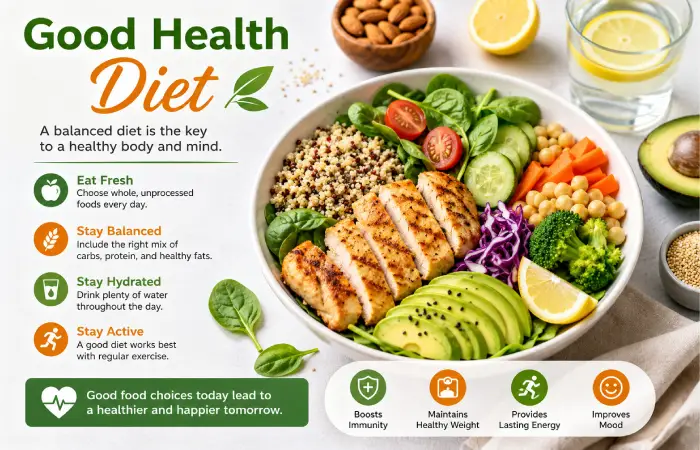
Proper diet is one of the basic elements of healthy living. Proper intake of food gives you energy, you get vitamins, minerals, proteins, fats, carbohydrates and other essential nutrients that our body wants to operate normally.
Eating a diet that’s healthy promotes healthy body weight, a normal immune system and normal growth and development, as well as reduces the likelihood of several chronic health problems.
Eating from different food groups is important because the diet you consume should be varied. Fruits as well as vegetables serve vitamins, minerals, fiber along with several of’other helpful ingredients’. Whole grain products can serve fuel as well as fiber, healthy proteins could consist of muscles along with other structures, and also healthy fats that help regular bodily procedures.
The choice and cooking of food are also important, dirty and fresh ingredients with the correct cooked meals can prevent it as easily and are simply taking precautions such as cleaning vegetables well and cooking everything correctly and keeping it clean.
Bit control is also about healthy eating. Overweight status is caused by consuming too much of even good foods, by sheer volume
For a specific example of nutritious food choices, you can also read about the health benefits and nutritional value of spinach.
Physical Exercise
Keeping active is also part of having a fit lifestyle. The type, amount and level of activity needed are different for people of all ages and depends on a person’s level of fitness, health and lifestyle, but exercise is important.
Being around nature is also important for your well being. Walking, doing gardening or being in the park or simply sitting outside on your own will get you physically active or simply get you relaxed.
Such activities could potentially reduce your stress levels and may even enhance your mood. Furthermore, exercise may allow you a chance to get a break from work and everyday responsibilities and a chance to give your mind and body a breather.
This is especially helpful for anyone that has to sit for long amounts of time. Brief, regular walks (even for only 5-10 minutes) and simple stretching, taking the stairs instead of an elevator when possible, or even incorporating basic exercise into your home routine will greatly decrease the amount of time spent immobile.
Anyone beginning any exercise regimen after having lead a sedentary life before needs to do so gradually. Anyone with medical conditions should seek the guidance of an experienced health care professional before starting any exercise program.
Hygiene
One of the important basics for health is good personal hygiene. Personal hygiene can protect you from dangerous bacteria, virus etc and the transfer of pathogens.
Handwashing is easy-Just make it a regular habit. Your hands come into contact with objects all day. Without washing your hands, you’ll touch your face or spread bacteria in other ways.
Washing our hands regularly, grooming nails, being in neat attire, frequent bathing, keeping our surroundings reasonably tidy are simple principles of hygiene.
Hygiene should also be specifically attended. Teeth brushing on a regular basis along with proper debridement can significantly improve oral hygiene. Visiting appropriate dentist is equally important.
Cleanliness has more purposes than simply avoiding infection; feeling and looking clean and smart can also add to personal confidence, ease and well-being.
Mental Good Health
Mental health is also known as emotional and psychological well-being and describes the relation to emotions, behavior, communication, learning and problem solving, work and interactions with others.
Good mental health can be defined as to be in a state in life where negative emotions like worry, stress, sorrow, and annoyance do not overcome the happy and positive aspects of life. There could be negative periods, but the person still functions. Maintaining personal relation ships and achieving daily tasks including work is considered good mental well-being.
People’s daily activities in contemporary life place them in contact with numerous forms of stress, which might appear in relation to work load, finances, family relations or society. Developing healthy means of dealing with daily stresses can accordingly play a crucial role in achieving well-being. Relaxing processes, physical exercise, plenty of sleep, interests, pleasant interaction with human beings and short pauses help in achieving a healthy emotional life.
One should not neglect mental, or in worst cases – emotional, illness: When symptoms begin to interfere negatively with your job, relationships and life in general. Seeking for professional assistance, from a medically qualified specialist or psychiatrist may prove to be a critical factor.
Social Activity
As we are social beings, relationships that we form within society can play an important role in our overall well being. Connections with relatives, friends, work-colleagues and people living in society offer both company and emotional support through encouragement and validation and a sense of inclusion.
It is not just about having a crowd of people around us: meeting with friends to chat; a meal with a family; belonging to the local committee; assisting other people by helping out at the local play-group or a family-time can improve individual well-being.
Having solid social bonds can help us get through a stressful or tough times too. Often, individuals with a good network have a go-to person for support during hardship, thus, preventing themselves from feeling all alone.
For a wider perspective on how social factors can influence well-being, see this guide to health equity and social determinants of health.
Connection With the Environment
Your living, working and recreation environment has potential affects on your health. Some conditions of your environment are to some extent controllable whereas other are not. Such as; poisoned atmosphere and water, excessive sound, unhealthy environment and other damaging elements; inclement weather conditions
Protecting yourself from environmental risks can be accomplished by taking safety measures, keeping a safe and hygienic environment, wearing protective equipment where needed, and being mindful of information presented on environmental health.
Being around nature is also important for your well being. Walking, doing gardening or being in the park or simply sitting outside on your own will get you physically active or simply get you relaxed.
An important aspect is developing an environment conducive to positive behaviors. Comfortable, convenient, clean, secure and organized physical settings are more conducive to healthy routines.
Genetic Endowment
A number of human factors can affect genetic factors. Each human possesses genetics from both of their parents, and some of the humans can make an individuals health condition a higher risk of having the same diseases. Not all of these have an immediate connection to you when having any risk.
It is also useful to appreciate one’s family history in health terms. Awareness of the prevalence of hereditary and chronic diseases within one’s immediate family might prove helpful when debating necessary screening with ones doctor, for example.
Epigenetics is another area of interest in health research. It refers to changes that influence how genes are expressed without changing the underlying DNA sequence. Environmental and lifestyle factors can influence some epigenetic processes.
Still genetics account for just one aspect of health. Healthy lifestyle behaviors as well as adequate screening and other forms of preventive care play a crucial role in avoiding a family history of disease.
Good Health Education
Health education increases people awareness to the outcome of their choices to their health and the availability of accurate health information would ease to differentiate the risk factors, recognize preventative practices, and also make adequate decision-making.
The field areas health education could include range from nutritional, exercise and physical activity, to personal hygiene, mental health, sexual health, disease prevention, use of medicines, importance of check-ups and etc..
Nowadays it’s very accessible to find health-related info, but not all health and medical content you find on the web is trustworthy. Online, you can easily run into exaggerated product claims, false product-guaranteeing claims or false medical advice.
For this reason, consumers must have trust in the data provided to them and see healthcare professionals when required.
Health education is beneficial in that it is far easier to prevent the development of avoidable health issues than manage them once established.
Adequate Sleep and Rest
Although Sleep is not always discussed when the time has come to address your health but it’s an important factor to Physical as well as in our Mental Health. Working while you’re sleeping.
Insufficient or poor-quality sleep can affect concentration, mood, energy levels, and daily performance. Long-term sleep problems may also be associated with broader health concerns.
Getting Good Sleep Peacefully By practicing good sleep habits: Establish Regular Bedtime Routine Sleep Environment and Reduce stimulation before bedtime .
The amount that you need is dynamic: Your sleep requirements evolve considerably as your age and the individual factors change. In the end, focus on quantity instead of sleep.
You don’t have to suffer through serious or disruptive sleep problems. Talk to your doctor. He or she will help discover the root cause and offer the best treatment.
Readers looking for additional information about improving their sleep can explore enhancing health through better sleep.
Staying Properly Hydrated
A range of body functions requires water, and correct water input is essential for normal bodily process. Increased intake of water is then needed where conditions involved high heat and extreme effort.
Water input will be varied on age, environment, and the individual’s food intake, physical and personal condition. Regular intake with due attention paid to body thirst is sufficient input for all individuals
If your work involves many days of strenuous work or it is a day of many long, hot hours in an extreme environment, you are even more apt to not recognize the cues when you need to hydrate well. Generally speaking most people, when thirsty throughout most of the day, reach first for the water instead of a sugary drink.
The amount of water a person needs can varies in relation to medical considerations; therefore you may be advised by a medical professional when such a case arises.
Stress Management
A certain amount of stress is a part of everyday life. Occasional brief stress may help someone’s response to situations, while chronic unremitting stress will lead to feelings of unease at all levels and physically damage them too.
Identifying the causes of the things that stress us out and coping in a healthy way can be helpful. Some approaches like taking regular exercise, getting enough sleep, relaxation time and activities, socialise with people, and manage our time are some great ways.
Dividing complex tasks into manageable pieces might make duties easier to deal with as well. Regular short breaks throughout a stressful task will prevent mental fatigue from consuming.
We need to accept that not all stressors will disappear. It is more about learning to handle stressors more effectively and setting up systems for a stronger self.
Seek out help when your stress is intense and continuous or significantly impair your life.
Escaping Harmful Habits
Not being a good health citizen means that we do not partake in actions that are destructive to our bodies. Smoking, excessive drinking, hurting drugs, and other such actions can underwrite to many health threats.
It is especially important to avoid tobacco as use of tobacco products and smoking damages many parts of the body and poses health risks including severe illnesses.
For a person working to overcome addiction, this task is almost impossible. A medical professional, counsellor, family or friends, or an organized recovery program can be a huge aid.
Good replacement behaviour’s can be helpful in this process, such as exercising, socializing, enjoyable hobbies and having a consistent structure in daily activities can be more positive outlets for distress or boredom.
Preventive Healthcare
Keeping yourself healthy involves more than just your actions in your own home. Regular doctor visits and other health check-ups are also valuable parts of your defensive healthcare routine.
Through preventive care services, your doctor can work with you to cover things like risk factors and screenings, your health history, immunizations and what other actions might make your best you.
Preventive screenings are determined by age, sex, medical background and lifestyle history of your family, as well as a person’s general health status.
Unusual or continuous symptoms and other matters of concern also should be addressed.
Enjoy Your Freedom and Free Time
It is the difficulty modern working life presents for finding time for downtime and personal life. Long hours at work, family needs, money problems, digital device notifications – the pressure to be ‘doing’ something constantly may dominate our lives.
However time with leisure it needs to be appreciated as not going to work and being relieved of previous pressures to allow people rest and conserve energy and maintain emotional stability.
Time to rest and relax doesn’t have to be expensive there is music or a good book, exercise the dog or go to park with children, spend it in the garden, or visit family and friends, enjoy cooking, going on holiday where possible or just take time to concentrate on what you enjoy or quiet contemplation.
Free time can also improve relationships. Shared enjoyable activities with loved ones enhance friendships, reinforce family relationships and lead to good memories..
The meaning of leisure is not that it is useful sometimes even being without guilt can be good.
Continuing a Healthy Work-Life Balance
Work is part of everyone’s lives, and although it can be consuming, should not take over from the need for sleep, relationships and personal enjoyment.
Work-life balance has everything to do with having enough room for the world of work to live harmoniously with physical needs, the need for family and friendships, fun and rest.
Constant work and lack of rest will result in tiredness and a lack of enthusiasm. Creating barriers between work and other aspects of the day could create more of a lasting arrangement..
The balanced life looks different to different individuals. The point is that health is not dependent on career obligations.
Building Healthy Habits
Sound health is generally the result of habits rather than of one or two great efforts. Little things become great when done daily.
Someone can start out with walking thirty minutes at a time each day; more fruits and veggies in; drinks more water; go to bed earlier; sit fewer hours each day, and etc.
Attempting to change everything simultaneously can be very challenging. Selecting just one or two attainable targets to slowly develop upon might be more manageable.
Monitoring progress may be helpful also, tracking individual ‘level of physical activity, sleep habits, dietary behavior or whatever else for example’ showing “where [they] stand as of where to go.
Most of all, setbacks should not be considered total failures. Living healthily is a lengthy endeavor and falls off the wagon from time to time.
For practical ideas that can be incorporated into everyday routines, readers can also explore simple lifestyle changes that lead to better health.
The Importance of Balance
Another of the fundamental keys to good health is balance. Good eating does not mean eliminating all desirable foods, working out does not mean never doing anything else and working too much is not inherently “good”. It is essential to have a good social network, but personal time is just as important.
Physical, mental and social well-being are intrinsically linked and someone can have the most perfect diet but have a life of suffering due to ongoing isolation and stress or someone could exercise relentlessly but benefit from improving their sleep, diet, social life or mental well being.
Good living does not simply look at one measure or habit in Isolation, but embraces an all round picture.
Simple Ways to Support Good Health Every Day
Change doesn’t always have to be revolutionary – something so large to throw everything off track. Why small regular improvements do make a massive difference.
Some applied habits include:
- Eat a diverse and balanced diet.
- Include fruits and vegetables regularly.
- Drink adequate fluids.
- Stay physically active throughout the day.
- Reduce protracted sitting when possible.
- Get sufficient, good-quality sleep.
- Maintain good personal and oral hygiene.
- Spend expressive time with family and friends.
- Find healthy ways to manage stress.
- Avoid tobacco and harmful substance use.
- Make time for hobbies and relaxation.
- Follow appropriate preventive healthcare recommendations.
- Learn to identify consistent health information.
- Pay attention to tenacious changes in physical or mental well-being.
- Create a safe and supportive living environment.
Someone can start out with walking thirty minutes at a time each day; more fruits and veggies in; drinks more water; go to bed earlier; sit fewer hours each day, and etc.
Frequently Asked Questions
What are the main issues that pay to good health?
The health of a person is influenced by the following factors: nutrition, exercise, sleep, hygiene, state of mind, social relationships, environment, genetic constitution of the body, etc. In lifestyle changes such as, in order to promote health.
Is exercise enough to maintain good health?
No, I would say exercise is certainly a part of it but not entirely. There are certainly other factors such as food, sleep, mental health, hygiene, social life, other health prevention steps etc.
Why is a balanced diet important?
Your body needs balanced nutritious diet for proper body functions. Nutrition is essential for growth and development, strong immunity, ability for physical activities, and long lasting health benefits.
How does mental health affect overall health?
As mental health and physical health are interrelated with each other, stress, sadness, problems of sleeping, emotional health and other mental wellness issues can cause effect on an individual’s physical condition. Good mental well being helps in a good physical health.
Why are social relationships important?
These positive interactions may also give us emotional support and companionship, as well as providing encouragement and a feeling of connection. Positive social links enhance our psychological and social health.
Conclusion
Good health doesn’t just mean being free from illness but is “a state of complete physical, mental, emotional and social well being and not merely the absence of disease and infirmity” and is attained at numerous levels.
An optimal diet can deliver essential nutrients, exercise can sustain fitness and strength, whilst hygiene can promote immunity.
Sleep is necessary for recovery.
Mental health is maintained through counseling, and social health is supported by having meaningful relationships.
Environmental consciousness, knowledge of genetics, health education, prophylaxis, and the renunciation of bad habits.
Perhaps most importantly, one should see the pursuit of good health as a long-term endeavor rather than just a short term objective. Minute, consistent changes to one’s lifestyle can, over time, result in a much healthier way of living.
When you think about the big picture- body, mind, relationships, environment and lifestyle-then the good health and quality of life will be built on more solid ground.
Good Health Resource Hub
Explore practical guides covering healthy lifestyle habits,
nutrition, better sleep, public health and simple ways to
improve your overall well-being.
You can also explore healthcare quality improvement tips for public health workers for additional information related to improving health and healthcare practices.