In modern education, question banks have emerged as indispensable tools, particularly in the study of biology. As the subject continues to expand with discoveries in genetics, ecology, and molecular biology, students often find themselves overwhelmed by the breadth and depth of content they must master. Question banks offer a structured and efficient solution by providing organized collections of practice questions categorized by topic, difficulty level, and exam format. These repositories are designed not only to test knowledge but also to reinforce learning, identify gaps, and build exam confidence.
By presenting a diverse array of questions, question banks enable students to actively engage with the material rather than passively reading textbooks. This active engagement significantly improves retention and comprehension. Furthermore, the integration of digital platforms has made these resources more accessible, interactive, and adaptive to individual learning styles. This article explores the many benefits of question banks in biology education, focusing on how they enhance learning outcomes, improve exam performance, and provide a cost-effective study solution.
Table of Contents
Boosting Exam Readiness
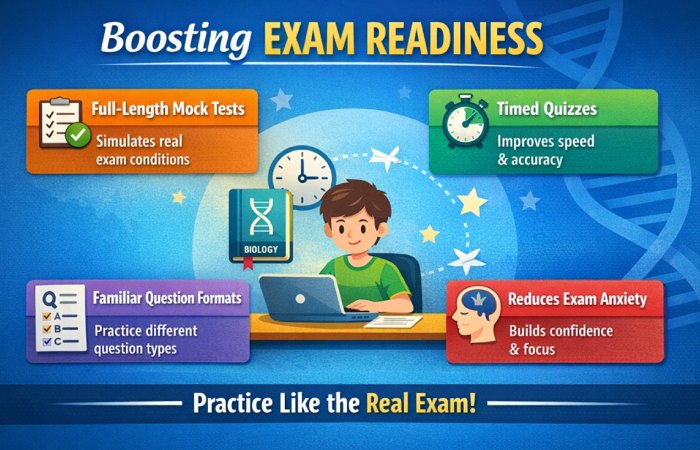
One of the most significant advantages of question banks is their ability to enhance exam preparation. Biology exams often require not only factual recall but also the application of concepts to new scenarios. Question banks simulate real exam conditions by offering a wide variety of questions that mirror actual test formats.
Students can take full-length mock exams that replicate the structure, timing, and pressure of real assessments. This exposure helps them become familiar with question patterns and reduces uncertainty. Over time, students develop endurance, allowing them to maintain focus throughout lengthy exams.
Timed quizzes are another essential feature. These exercises train students to think quickly and accurately under pressure. By practicing within time limits, learners improve their pacing and learn to allocate appropriate time to each question. This skill is crucial in competitive exams where time management can significantly impact scores.
Exam Preparation Features of Question Banks
| Feature | Description | Benefit to Students |
|---|---|---|
| Full-Length Mock Tests | Simulates real exam conditions | Builds confidence and exam familiarity |
| Timed Quizzes | Practice under time constraints | Improves speed and accuracy |
| Topic-Wise Questions | Organized by subject areas | Ensures comprehensive coverage |
| Difficulty Levels | Easy to advanced questions | Gradual skill development |
| Instant Feedback | Immediate evaluation of answers | Quick error correction |
Additionally, repeated exposure to different types of questions allows students to recognize recurring themes and frequently tested topics. This insight helps them prioritize their study efforts effectively.
Mastering Key Concepts
Understanding core biological concepts is essential for academic success. Question banks support this by encouraging repeated interaction with key topics. This repetition strengthens memory through a technique known as active recall, where students retrieve information from memory rather than simply reviewing it.
Each time a student answers a question, they reinforce neural pathways associated with that knowledge. Over time, this leads to faster recall and deeper understanding. This method is particularly effective in biology, where concepts such as cell division, enzyme activity, and ecological systems require both memorization and comprehension.
Another major advantage is the detailed explanation provided for each answer. These explanations clarify why a particular answer is correct and why others are not. This immediate feedback helps students learn from mistakes and prevents misconceptions from forming.
Concept Mastery Through Question Banks
| Learning Method | How Question Banks Support It | Outcome |
|---|---|---|
| Active Recall | Repeated questioning | Stronger memory retention |
| Spaced Repetition | Revisiting topics over time | Long-term knowledge retention |
| Immediate Feedback | Detailed answer explanations | Better understanding of concepts |
| Application Practice | Scenario-based questions | Improved analytical skills |
| Error Analysis | Review of incorrect answers | Identification of weak areas |
Through consistent practice, students not only memorize facts but also develop the ability to apply knowledge in different contexts—a critical skill in biology exams.
Sharpening Time Management Skills
Time management is a crucial skill for academic success, especially in exams where students must answer numerous questions within a limited timeframe. Question banks provide an ideal platform for developing this skill through timed practice sessions.
By regularly practicing under time constraints, students learn to allocate time efficiently across different sections. They also develop strategies such as skipping difficult questions and returning to them later, which can significantly improve overall performance.
Time Management Benefits
| Practice Strategy | Description | Result |
|---|---|---|
| Timed Practice Tests | Simulated exam timing | Better pacing |
| Section-Based Timing | Allocating time per topic | Balanced performance |
| Speed Drills | Quick-answer exercises | Faster response time |
| Review Sessions | Post-test analysis | Improved future performance |
| Question Prioritization | Identifying easy vs. difficult questions | Efficient time allocation |
Exposure to various question types also teaches students how to adjust their time usage. For example, multiple-choice questions may require less time than essay-based questions, and practicing this balance is essential.
Pinpointing Weaknesses
One of the most powerful features of question banks is their ability to help students identify their weaknesses. By analyzing performance across different topics, students can determine which areas require more attention.
Many modern question banks include performance analytics that track accuracy, speed, and progress over time. These insights allow students to create personalized study plans tailored to their needs.
Performance Tracking and Analysis
| Feature | Function | Advantage |
|---|---|---|
| Accuracy Tracking | Measures correct vs. incorrect answers | Identifies strengths and weaknesses |
| Progress Reports | Monitors improvement over time | Motivates consistent study |
| Topic Analysis | Breaks down performance by subject area | Focused revision |
| Difficulty Insights | Tracks performance by question level | Skill-level assessment |
| Custom Study Plans | Suggests areas for improvement | Efficient learning strategy |
For instance, if a student consistently performs poorly in genetics, they can dedicate more time to that topic. This targeted approach is far more effective than general revision.
Exposure to Diverse Question Formats
Biology exams often include a mix of question types, each requiring different skills. Question banks expose students to multiple formats, including multiple-choice, short answer, and essay questions.
This diversity helps students become adaptable and confident in handling various exam scenarios. Each format also enhances different cognitive abilities:
- Multiple-choice questions improve quick decision-making
- Short answers enhance clarity and precision
- Essays develop critical thinking and structured writing
Types of Questions and Skills Developed
| Question Type | Skill Developed | Example Use Case |
|---|---|---|
| Multiple Choice | Quick recall and accuracy | Objective exams |
| Short Answer | Concise explanation | Concept-based questions |
| Essay Questions | Critical thinking and analysis | Long-form responses |
| Diagram-Based | Visual interpretation | Labeling biological structures |
| Case Studies | Application of knowledge | Real-world biological problems |
By practicing all formats, students gain a comprehensive understanding of the subject and improve their ability to approach questions from different angles.
Convenience and Accessibility
The digital transformation of education has made question banks more accessible than ever. Online platforms and mobile applications allow students to study anytime and anywhere, making learning more flexible and convenient.
Whether commuting, waiting in line, or taking a short break, students can utilize these moments for productive study. This flexibility is particularly beneficial for those balancing academics with other responsibilities.
Accessibility Features of Online Question Banks
| Feature | Description | Benefit |
|---|---|---|
| Mobile Access | Study via smartphones | Learning on the go |
| Cloud Storage | Saves progress online | Seamless continuation |
| Search Function | Find topics quickly | Efficient navigation |
| Offline Mode | Access without internet | Uninterrupted learning |
| User-Friendly UI | Easy-to-use interface | Enhanced user experience |
These features ensure that students can maintain consistent study habits regardless of their schedule.
Budget-Friendly Study Solution
Traditional study resources such as textbooks and private tutoring can be expensive. Question banks offer a cost-effective alternative without compromising quality.
Many platforms provide free access or affordable subscription plans, making them accessible to a wide range of students. This affordability democratizes education by providing high-quality resources to those who may not afford expensive coaching.
Cost Comparison
| Study Resource | Average Cost | Accessibility | Effectiveness |
|---|---|---|---|
| Textbooks | High | Limited | Moderate |
| Private Tutoring | Very High | Limited | High |
| Question Banks | Low to Free | High | High |
| Online Courses | Medium | High | High |
| Study Groups | Free | Variable | Moderate |
The combination of affordability and effectiveness makes question banks an excellent investment for students.
Essential Tools for IB Biology Preparation
For students preparing for advanced curricula like IB Biology question banks tailored to the syllabus are invaluable. These specialized resources align closely with exam requirements and provide targeted practice.
They cover all syllabus topics and include exam-style questions with detailed explanations. This alignment ensures that students are well-prepared for the specific challenges of IB exams.
IB Biology Question Bank Features
| Feature | Description | Benefit |
|---|---|---|
| Syllabus Alignment | Matches IB curriculum | Relevant practice |
| Exam-Style Questions | Mirrors actual exam format | Better preparation |
| Detailed Solutions | Step-by-step explanations | Deep understanding |
| Topic Coverage | Includes all syllabus areas | Comprehensive learning |
| Practice Tests | Full exam simulations | Confidence building |
Students who use these resources often report improved performance and greater confidence.
Insights from Educators
Educators widely recognize the value of question banks in enhancing student learning. Teachers often integrate these tools into their teaching strategies to provide structured practice and reinforce classroom instruction.
They emphasize that question banks promote active learning, where students engage directly with the material rather than passively reading. This approach leads to better retention and understanding.
Educator Perspectives
| Insight | Explanation | Impact on Students |
|---|---|---|
| Structured Learning | Organized practice approach | Improved focus |
| Active Engagement | Encourages participation | Better retention |
| Immediate Feedback | Quick correction of mistakes | Faster improvement |
| Personalized Learning | Tailored study plans | Efficient preparation |
| Continuous Assessment | Regular performance evaluation | Consistent progress |
Teachers also note that students who regularly use question banks tend to perform better in exams due to their familiarity with question patterns and improved confidence.
Embracing the Power of Question Banks
Question banks have revolutionized the way students approach biology education. They offer a comprehensive, flexible, and effective method for mastering complex concepts, improving exam readiness, and developing essential skills such as time management and critical thinking.
By integrating question banks into daily study routines, students can transform their learning experience. These tools not only make studying more engaging but also ensure a deeper understanding of the subject.
Whether preparing for school exams, competitive tests, or advanced programs like IB Biology, question banks provide the support needed to succeed. Their accessibility, affordability, and proven effectiveness make them an essential resource for modern learners.
In a world where education continues to evolve, embracing tools like question banks can give students a significant advantage—helping them achieve their academic goals with confidence and efficiency.