Last Updated: September 17, 2026
Table of Contents
The Pursuit of Health Equity
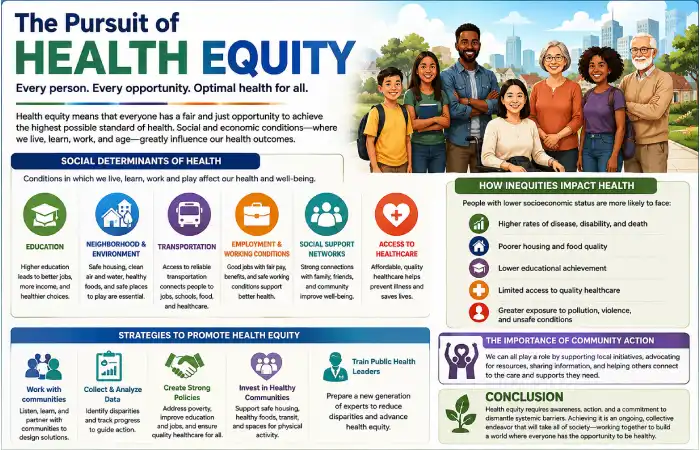
Public health’s aspiration is that every person has the opportunity to achieve the highest possible standard of health equitable: in a fair and just manner. However, it’s not yet a reality. Social and economic conditions – the places we are born, grow up, live, work, and age – are often driving health inequities between different segments of society. Here we examine how health is impacted by these conditions and explore ways we can work toward greater health equity.
Social determiners of health encompass many factors ranging from socioeconomic status, the environment, neighbors, education, working life, the family and support networks and care access. Higher disease disability and death rates appear in lower socioeconomic status populations.
Higher levels of exposure of those with lower socioeconomic status to adverse factors such as food and housing quality and education and economic opportunity, lack ofaccess to sufficient and appropriate healthcare.
Understanding these factors is also an important part of maintaining overall well-being. Simple daily habits, access to healthy choices, and appropriate support can all contribute to better health outcomes. You can learn more about practical approaches in simple lifestyle changes that lead to better health.
These problems tend not to appear alone – and they come at once. Simply being unable to afford to go anywhere other than a few selected neighborhoods, for instance, can expose you to more toxins, have inadequate access to safe public transportation, limit you in buying healthy foods and finding the right doctor. Lack of a car can even make it impossible to get to appointments with health providers, a food store and even a job.
Starting a trend in healthier living with education: Higher levels of education lead to longer and healthier and more productive lives! Education translates to better jobs, more money, healthy living, and the information to make healthy life style decisions. Interested in using your higher level knowledge to develop solutions that combat health challenges? The public health Bachelor’s degree could be for you.
Education can play a role in health behavior through its impact on system navigation, and choices regarding disease prevention and treatment. Educational institutions offer an environment for school age children to learn about diet and exercise, mental health and well being, and disease prevention. Education can lead to improvements through various channels when it starts early.
Neighborhoods and physical environments are large influencers of health. To live healthy lives we must have safe housing, healthy foods, clean air and water, good education and safe spaces to play, but for some this isn’t always possible, many minority and low income communities now face excessive violence, pollution and unsafe housing, resulting in poor outcomes.
Transportation is another factor within the built environment. It can facilitate access to jobs, schools, the grocery store, and doctors’ visits. Lack of transit and safe places for roads also contributes to isolation. City planning is an area that can consider how houses, transit, opportunities to play, and access to food work together to create healthy circumstances to live in every day.
Employment and working conditions are another important factor. Lack of employment, part-time work, dangerous or otherwise strenuous work and absence of health benefits among workers are all health determinants. Fair employment provides access to housing in desirable, healthier environments and a greater capacity to attain a healthy diet, healthcare and space/time for leisure activities.
Workplace policies could also serve as a component of health equity initiatives. Good workplace conditions, job security and a pathway toward economic security could help relieve some pressure in our lives that makes people unwell. In concert with business and community, public health programs could identify workplace barriers people face in access to resources that could improve their health.
Social networks significantly impact individual health. Studies has found that both social isolation and low social support correlate with an increased likelihood of suffering from illness (like heart disease) and/or psychological illness. Creating strong networks, and community support systems are effective defense measures against illness and excellent means of recovery.
You can build your support system from family members, friends and at social sites such as at the local work-place, community groups/ clubs. Community-based social support connections have been linked to more effective responses to challenges, higher levels of resistance and the enhancement of community and individual well-being.
Lastly, I want to point out accessibility. Minor issues can be exacerbated into serious diseases if one doesn’t have the resources access the best preventive and treatment care. The United States must have a system of quality and affordable healthcare.
Strategies to Promote Health Equity
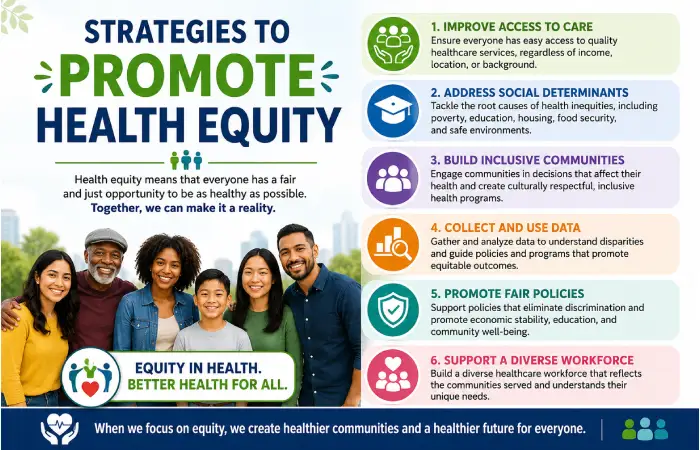
To realize health equity, we need to address the entirety of the social determinants of health with coordinated, multifaceted policies – policies to eradicate poverty, improve educational and job opportunities, promote healthier neighborhoods, and afford access to health coverage for everyone. We also must train a new generation of public health experts equipped to plan and implement the policies and programs that will reduce disparities.
The action plans should incorporate working with target communities. Communities are made up of individuals living within their own community and they are generally aware of the issues within the neighborhoods and effective means of addressing them. This knowledge can then be utilized when the organization designs programs, conducts analysis and determines distribution of resources.
Health can be understood by comparing health status information and recognizing populations facing greater barriers to health status differences. By comparing information about variables such as income level, housing circumstances, educational attainment, access to healthcare and environments, public health practitioners can assess health inequalities and evaluate programs.
For additional information about how social conditions can influence health and well-being, readers can explore the Social Determinants of Health resources from the Centers for Disease Control and Prevention.
The Importance of Community Action
In everyday life, people and the broader community can support health equity. We can advocate for and support neighborhood food markets, community health education, transit options and personal supports to minimize obstacles to achieving good health. We can advocate and assist others to connect to needed resources and to share helpful information.
Health equity is not everyone needing the same resources or everyone treated the same. Health equity is aiming for people to have the equal opportunity to reach their greatest level of health. Since not everyone starts from the same point it is going to take flexibility, collaboration, and attention on the factors facing populations.
Access to reliable healthcare and effective public health programs can also support communities in addressing these differences. Improving healthcare quality and public health practices can help organizations identify barriers and develop approaches that better respond to community needs.
conclusion
health equity necessitates awareness of the social determinants of health and a commitment to dismantle the systemic inequities that lead to health inequities. Achieving health equity is an ongoing and collective endeavor. It will take all of society-not only the health care system-working together to build a world where health equity is a reality for everyone.
Individual and community efforts can also contribute to healthier lives. Learning how to maintain good health through practical habits can complement broader efforts to improve health conditions and access to resources.
Good Health Resource Hub
Explore practical guides covering healthy lifestyle habits,
nutrition, better sleep, public health and simple ways to
improve your overall well-being.