

Last Updated: September 16, 2026
Push and pull when doing workouts When you do push vs pull workouts you are organising the resistance training to do with the two key movement patterns. Push in the workout probably involves you pushing the weight away from you.
This type of split is favored by people who like to have a routine plan at the gym, but who don’t want to train the same group on consecutive days
Table of Contents
What Is a Push vs Pull Workout?
The simplest way to see the difference in terms of moving is to look the direction of your moving body. Push movements will train the chest, shoulder and tricep, but the lower body is also capable of doing push.
Examples include:
- Bench press
- Push-ups
- Overhead shoulder press
- Dumbbell chest press
- Squats
- Leg press
Pull movements usually it include the back and elbow-flexing muscles, including the biceps.
Examples include:
- Pull-ups
- Lat pulldowns
- Seated rows
- Dumbbell rows
- Face pulls
- Biceps curls
The terminology of push and pull applies to the exercise performed, not the muscles worked, hence a push / pull split refers to training scheduling not the mechanics of muscular training.
Push vs Pull Workout: Main Differences
| Feature | Push Workout | Pull Workout |
| Main movement | Pressing resistance away | Pulling resistance towards you |
| Common muscles | Chest, shoulders, triceps | Back, rear shoulders, biceps |
| Example exercise | Bench press | Seated row |
| Bodyweight example | Push-up | Pull-up |
| Typical goal | Pressing strength and muscle development | Pulling strength and back development |
| Equipment | Dumbbells, barbells, machines or bodyweight | Cables, dumbbells, barbells or bodyweight |
A balanced programme can comprise both types of movement somewhat than giving them as competing methods.
How Does a Push Workout Work?
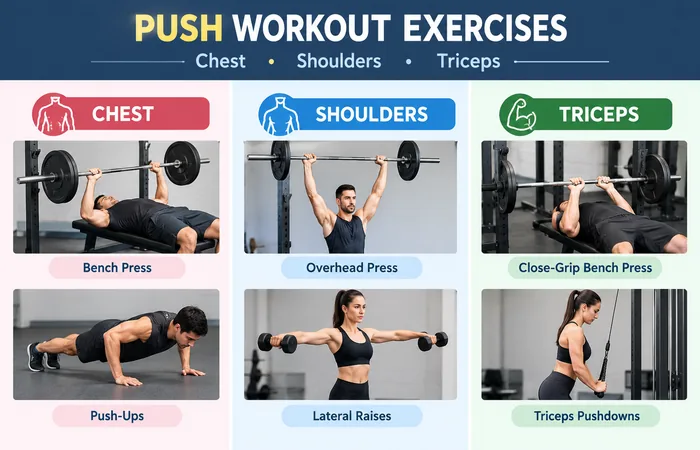
A push session brings several pressing exercises together.
A beginner session might include:
- Dumbbell bench press — 2–3 sets
- Machine or dumbbell shoulder press — 2–3 sets
- Incline press — 2–3 sets
- Lateral raises — 2–3 sets
- Triceps extensions — 2–3 sets
The number of exercises and sets must depend on exercise experience, rescue and the rest of the daily plan. More exercises are not routinely better.
How Does a Pull Workout Work?
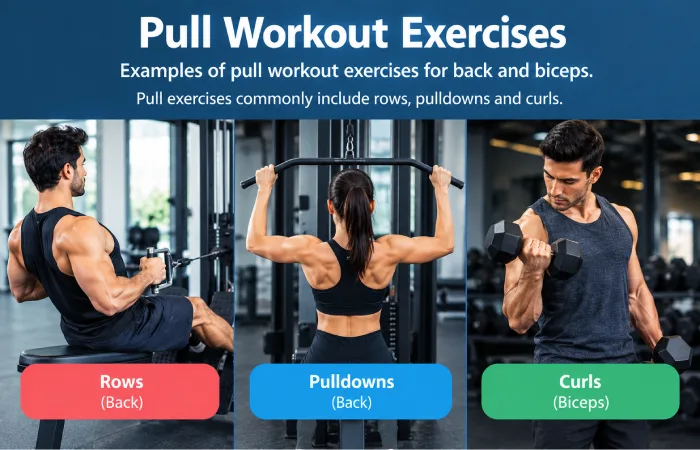
A pull session focuses on exercises where you pull resistance towards your body.
A simple example could include:
- Lat pulldown — 2–3 sets
- Seated cable row — 2–3 sets
- Dumbbell row — 2–3 sets
- Face pulls — 2–3 sets
- Biceps curls — 2–3 sets
Having good technique is more important than loading the body with heavier weight. If you have to compromise on range of motion to manage the weight, then there are safety reasons to lift lighter.
Example Push-Pull Workout Schedule
One advantage of a push-pull structure is that it can be adapted to different schedules.
Two days per week
Monday: Push
Thursday: Pull
This is a open starting point, though a two-day routine should also study workouts that train the lower body and other main muscle groups.
Four days per week
Monday : Push
Tuesday : Pull
Thursday : Push
Friday : Pull
This provides regular exposure to both movement patterns while leaving rest days between some sessions.
Three days per week
A three-day routine can rotate the emphasis rather than trying to force a fixed seven-day pattern.
Week 1: Push → Pull → Full body
Week 2: Pull → Push → Full body
The best arrangement depends on the person’s schedule and total training volume.
Push-Pull Workout Planning: A Simple Workflow
Use this process when building a routine:
Step 1: Determine your ultimate goal – strength, gaining muscle, or general fitness?
Step 2: Select exercises that target the primary movement patterns.
Step 3: Begin with a training volume that’s easy to handle.
Step 4: Use controlled method and an appropriate resistance.
Step 5: Record your workouts, sets and repetitions.
Step 6: Gradually increase resistance, repetitions or training volume as your ability improves.
Step 7: Review your recovery and adjust the programme if necessary.
The advice for training provided by ACSM says that, “Programming is better than complex programming,” and that resistance can be introduced through free weight exercises, machine exercises, body weight exercises, and band exercises.
What Results Can You Realistically Expect?
A push-pull routine can support improvements in strength and muscle development, but results do not come from the split alone.
Progress is influenced by factors such as:
- Training consistency
- Exercise technique
- Training volume
- Resistance used
- Nutrition
- Sleep and recovery
- Previous training experience
- Individual differences
The 2026 ACSM resistance-training guidance highlights different approaches for different goals. For example, strength-focused training may use heavier loads, while muscle-growth programmes generally benefit from sufficient weekly training volume.
There is also no need to assume that a complicated programme will produce faster results. A simpler routine that someone follows consistently can be more useful than an advanced plan that is difficult to maintain.
Benefits and Limitations of Push-Pull Training
Potential benefits
- Easy-to-understand structure
- Groups similar movement patterns together
- Can provide recovery between sessions
- Works with gym or home equipment
- Can be adapted to different schedules
- Makes weekly training easier to organise
Limitations
- It does not automatically guarantee balanced training.
- Beginners may not need a complex split.
- Lower-body movements need to be included appropriately.
- Excessive volume can affect recovery.
- Exercise selection still matters.
- People with injuries or medical conditions may need individual guidance.
The broader physical-activity guidance commends muscle-strengthening activity involving the major muscle groups on at least one or two days each week for grownups.
Who Should Try a Push-Pull Routine?
A push-pull structure may suit:
- Intermediate gym users who want more organisation
- People who enjoy resistance training
- Individuals training several days per week
- People who want a straightforward way to separate movement patterns
- Those who prefer a repeatable weekly routine
This might not be very helpful for the total beginner, as they might need to be taught some of the basics movement patterns, and basic resistance training skills first.
Always consult your healthcare professional before embarking on this program if you have a previous injury, current pain, a health condition or if you’ve been told to limit your exercise.
Push vs Pull Workout: What About Leg Exercises?
The neglect of leg training is sometimes attributed to the programme structure being push versus pull. Squats, lunges, leg presses all have a push through the legs pattern whereas Romanian deadlifts, some hamstring movements are pull or hip-hinge based.
Therefore a more holistic resistance programme should look at the entire body rather than just counting through the chest and back.
FAQ’s
What is the difference between a push vs pull workout?
Push workout vs pull workout Push and pull workout routines are based on how an exercise move you. If you’re going to do a push workout, then you will do some sort of pressing motion – as the name would suggest! Instead, in a pull exercise you will pull the resistance into you.
Is push or pull better for building muscle?
Neither is inherently superior. They can both be muscled-up in the right training context and with adequate regular training. For example, the outcome depends on things like exercise choices, training volume and effort, nutrition and recovery.
Can beginners do push-pull workouts?
Yes, but obviously beginners don’t need a complex split. You might be better off doing a full-body workout every time you train and get to grips with the basics before advancing onto a more specialised plan.
How many days a week should I do push and pull workouts?
I don’t think there is a set number. Your plans need to accommodate a reasonable amount of training to work the large muscle groups without under recovery. I think the current ACSM advice focuses more on regular resistance training than any one set programme.
Can I do push and pull on the same day?
Yes. A full-body workout can include both pushing and pulling movements. Combining them can be particularly practical when you only have a few days available for resistance training.
Conclusion
A push vs pull workout is mainly a method for organising resistance exercises, not a rule that every person needs to follow. Push sessions generally centre on pressing movements, while pull sessions focus on pulling movements, with lower-body exercises incorporated according to the overall programme.
For the majority of individuals, a routine that activates all the key groups, is sustainable, and works within their timetable should be the main focus. The latest evidence-based guidelines, would also promote a more individualised approach to resistance training based on the user’s goals, experience, and ability to recover, rather than assuming one complex split plan is suitable for everyone.